Jared’s Ultimate Japanese Guide Chapter 14 第十四章
Roadmap and resources
道しるべ
The whole guide as a checklist you can tick off, what I think about the JLPT, every resource in one place, and other guides worth reading.
Here’s the whole guide boiled down into stages you can tick off as you go, saved in your browser. The stages are rough and they overlap a lot, so nobody fails for doing them out of order.
The roadmap
How long does all this take?
It depends on your hours more than your calendar. With a lot of time you can get pretty decent in two or three years, and SevenStop scored near-perfect on the N1 at around three. Getting near-native can take ten or twenty. It’s a lifelong thing, and it isn’t a straight line. The first couple of years build the foundation. The rest is fine-tuning and filling in specialized words. For me it’s been over 4,000 hours so far, and I’m still まだまだ, which is literally the channel name.
Should you take the JLPT?
The JLPT is the official proficiency test, from N5 (the easiest) up to N1. My take is to take it if you plan to work in Japan, or if you’re just curious where you stand. Just know that a certificate and real ability don’t always line up. It only tests reading and listening, so there are people who pass N1 and can’t hold a conversation, and people who can’t pass N3 who chat with natives all day. For jobs, N3 is okay to get started, N2 is what a lot of companies prefer, and N1 is mostly a flex, though it does help with some visas and jobs. It’s held twice a year (July and December) in most places, in person, and costs about $100 in the US.
I failed the N2 twice before passing on my third try, and both times my weak spot was reading. So I spent a year on web novels and visual novels (sometimes muting an anime and using only the Japanese subtitles), watched 日本語の森’s N2 prep videos, which are in simple Japanese, and did two or three timed mock exams. I printed those at a konbini, pressed the wrong size option, and carried three chest-sized JLPT packets through the streets while people stared. Anyway, I passed, and I’m taking the N1 this December.
About the new CEFR chart
The JLPT now publishes a chart that converts your score into a CEFR level, the international A1 to C2 scale used for English, Spanish and so on, so passing N3 with 110 or more counts as B1, for example. But the JLPT only tests what you understand, while CEFR also describes what you can do, like speaking. If you barely pass N3 and put “B1” on your résumé, an employer will assume you can talk at that level, so I’d wait until your speaking and writing can back it up.
Video Huge JLPT Update
Every resource, in one place
Other guides worth your time
No single guide has all the answers, including this one. These are the people and guides that shaped how I learn, plus a couple of lesser-known ones that people in our Discord love:
- TheMoeWay: the go-to written immersion guide, with detailed setups and resources. Its chapter layout inspired this guide’s.
- DASmallWorlds’ An Introduction to Japanese: an annotated list of the resources that took him to N1 and Kanji Kentei study. He took the structured route (Genki → Quartet, WaniKani, Bunpro, monolingual dictionaries, writing kanji by hand), and he’s very well regarded in the AJATT community. If you like structure, read it. Two lines from it I love: “the best method is the one you don’t give up on,” and “don’t skimp out on your SRS reviews.”
- SevenStop: near-perfect N1 in about three years, and great videos on grammar, passive immersion, and getting into Japanese universities.
- Hypothetical Tiger: immerse, make cards from immersion, rep cards, repeat until fluent. And actively do the skill you want to get better at. His AJATT updates with output sections are great to watch.
- Wyatt (Furretar): just cracked. Mined every unknown word he ever saw.
- Matt vs Japan: the guy who got a lot of us into immersion in the first place.
- Immersion-Based Japanese Learning (donkuri): a really nice immersion guide written for everyone, from one person’s point of view.
- The Lazy Guide: more of a tool-setup guide than a how-to-learn guide, with everything preconfigured. Great if the setup in chapter 5 felt like a lot.
Video How to Become Fluent in Japanese (Q&A)
One last thing
If you take one thing from all fourteen chapters, take this: there’s no rush. Every word is one more stone on your mountain. Find stuff you love, mine a little, review a little, sleep, and come back tomorrow. Make mistakes and collect the stories, and go talk to people. And when you hit a milestone, like your first manga, your first real conversation, or the first time you catch yourself thinking in Japanese without trying, come tell us in the Discord. I want to hear about it.
As always, keep learning, keep immersing, and I’ll see you around.
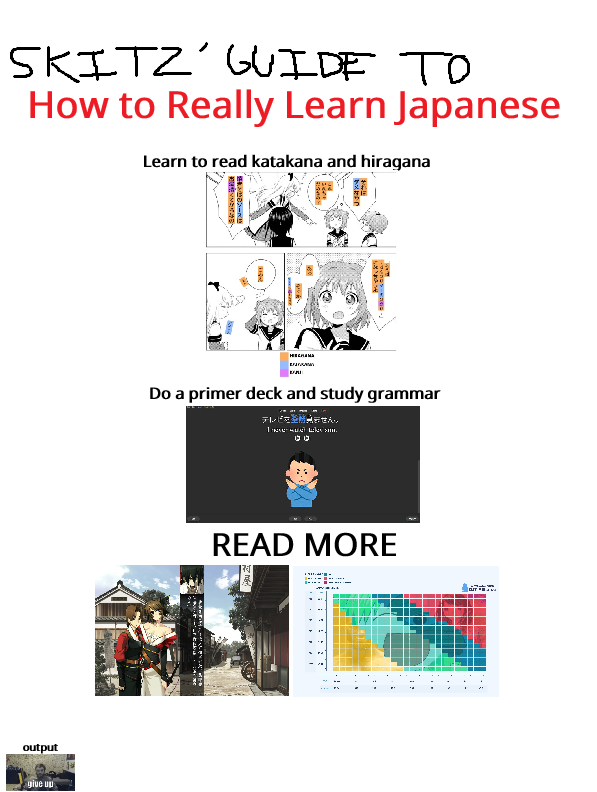
P.S. Short on time? Here’s the entire guide in one image.